Securing a scholarship is no longer just about academic merit; it is about the architecture of your narrative. With the rising cost of higher education in the United States—where the average annual cost for a private four-year college now exceeds $40,000—the competition for institutional and private funding has reached an all-time high.
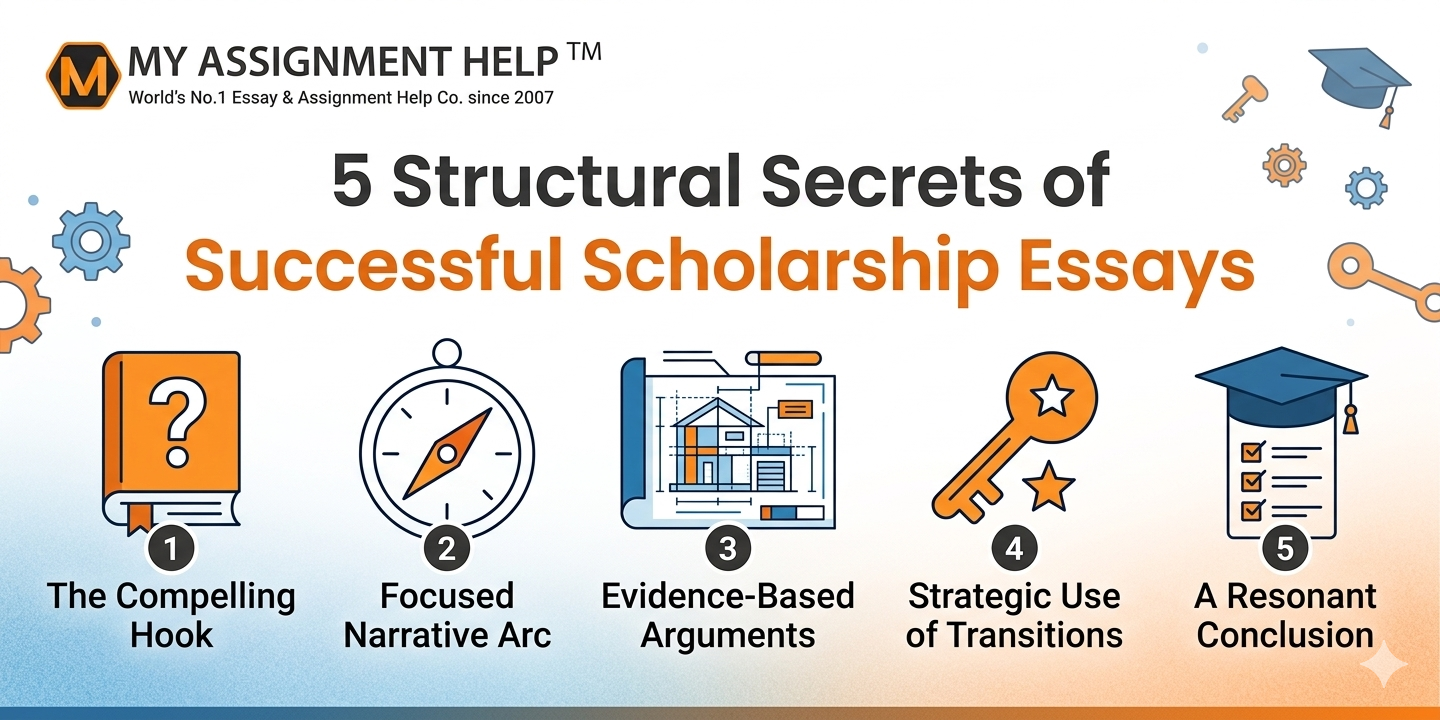
To stand out in a pool of thousands, your essay must do more than “tell a story.” It must employ a structural strategy that aligns with the psychology of scholarship committees. Below, we break down the five structural secrets that transform a standard personal statement into a high-conversion scholarship essay.
1. The “Hook-and-Pivot” Introduction
Most students begin with a chronological history of their life. However, data from admissions consulting suggests that committee members spend an average of 45 to 60 seconds on the initial read. A successful structure utilizes a “Hook-and-Pivot” mechanism.
The Hook is a visceral, specific moment in time—not a broad generalization. The Pivot then connects that specific moment to the broader scholarship prompt. For instance, instead of saying “I have always loved science,” start with the specific smell of a chemistry lab after a failed experiment and pivot to how that failure fueled your resilience.
When the stakes are this high, many students seek professional guidance to ensure their narrative arc is flawless. Utilizing a scholarship essay writing service can provide the objective editorial eye needed to sharpen these transitions, ensuring the “pivot” feels organic rather than forced.
2. The “Bridge of Impact” (The STAR Method Applied)
The middle of the essay is where most candidates lose momentum. The secret to maintaining authority (E-E-A-T) is utilizing the STAR method (Situation, Task, Action, Result), but with a structural emphasis on the Result.
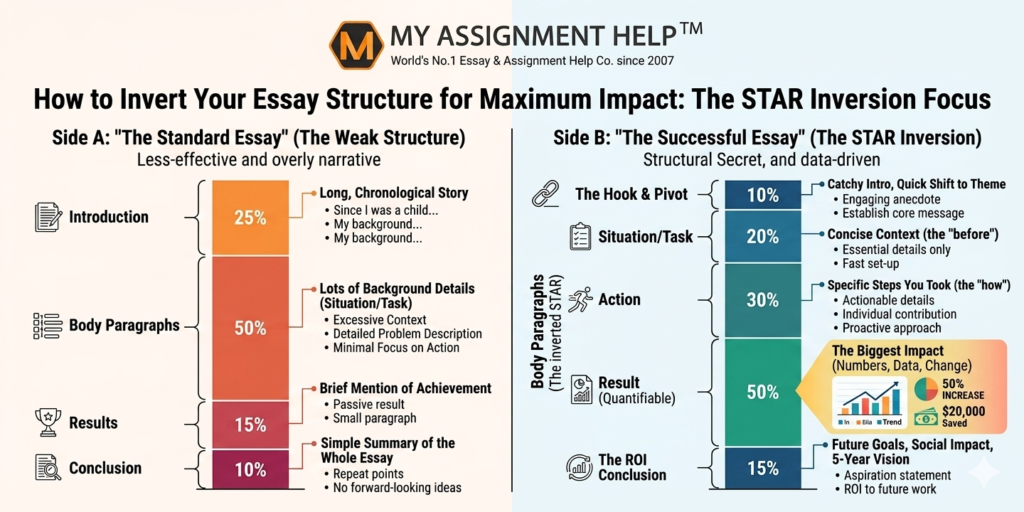
A common mistake is spending 80% of the word count on the “Situation” and only 20% on the “Result.” To be successful, the structure should be inverted. Committees are looking for “Social Proof” of your potential.
- Situation/Task (20%): Brief context.
- Action (30%): What you specifically did.
- Result (50%): The quantifiable impact. Did you raise $2,000? Did you reduce waste by 15%? Numbers provide the “Trustworthiness” that qualitative descriptions lack.
For students balancing heavy course loads while applying for funding, the cognitive load can be overwhelming. It is common to think, “I need someone to do assignment for me” just to find the time to focus on these critical scholarship drafts. Managing your time by outsourcing routine coursework allows you to dedicate the necessary 10-15 hours required for a winning essay structure.
3. The “Thematic Thread” Strategy
A winning essay is not a list of achievements; it is a unified argument. Structural success relies on a “Thematic Thread”—a single core value (e.g., “Iterative Growth,” “Community Advocacy,” or “Technical Curiosity”) that appears in every paragraph.
In the structural blueprint, each body paragraph should start with a transition that references this theme. This creates a “sticky” essay that is easy for a tired reviewer to remember. If your theme is “Resilience,” every anecdote—whether about sports, academics, or family—must explicitly tie back to how resilience was tested and strengthened.
4. Strategic Alignment with the Donor’s Mission
Every scholarship donor has a “Pain Point” or a “Mission Gap” they are trying to fill. A structural secret used by top-tier applicants is the Mirroring Technique.
Before writing, analyze the donor’s mission statement. If the Coca-Cola Scholars Foundation emphasizes “Leadership” and “Service,” your essay structure should dedicate specific sections to those two pillars. Structurally, this is often done through a “Service-Leadership Interlock” paragraph, where you demonstrate how your leadership directly resulted in community service. This demonstrates “Expertise” in understanding the organization you are applying to.
5. The “Forward-Looking” Conclusion (The ROI)
Most essays end by summarizing what was already said. A successful structure, however, ends by projecting a “Return on Investment” (ROI).
Scholarship committees are essentially venture capitalists for humans. They aren’t just rewarding your past; they are investing in your future. Your conclusion should structurally move from the “Micro” (how the money helps you) to the “Macro” (how your education will eventually help society). This final section should account for the last 15% of your word count and leave the reader with a clear vision of your 5-year post-graduation impact.
Key Takeaways
| Feature | Structural Secret | Why It Works |
| Intro | The Hook-and-Pivot | Grabs attention in <10 seconds. |
| Body | STAR Inversion | Prioritizes quantifiable results over fluff. |
| Theme | Thematic Thread | Ensures the essay is memorable and cohesive. |
| Strategy | Mission Mirroring | Aligns your goals with the donor’s values. |
| Outro | The ROI Projection | Positions you as a high-value investment. |
Frequently Asked Questions (FAQ)
Q: How long should a scholarship essay be if no word count is provided?
A: If no limit is specified, aim for 500–800 words. This is long enough to show depth but short enough to respect the committee’s time.
Q: Can I reuse the same essay for different scholarships?
A: You can reuse the “core” anecdotes, but the “Mission Mirroring” (Secret #4) must be adjusted for every single application to ensure alignment with specific donor goals.
Q: Should I mention my financial need in the essay?
A: Only if the prompt asks for it. If it’s a merit-based scholarship, focus on your achievements and ROI. If it’s need-based, be honest but focus on how the funds will enable your future success.
Q: Is it okay to get professional help with my essay?
A: Yes. Professional editors can help with structure, tone, and grammar. However, the core ideas and “voice” must remain your own to maintain “Experience” and “Authoritativeness” under EEAT guidelines.
About the Author: Sarah Jenkins
Sarah Jenkins is a Senior Academic Consultant at MyAssignmentHelp with over 12 years of experience in admissions counseling and content strategy. Holding a Master’s in Educational Leadership from NYU, Sarah has helped hundreds of students secure over $2.5 million in cumulative scholarship funding. She specializes in narrative mapping and E-E-A-T compliant academic writing.
Data Sources & References
- National Center for Education Statistics (NCES): Trends in College Pricing and Student Aid (2023-2024).
- The College Board: “Trends in Higher Education” series regarding the competitive landscape of private grants.
- U.S. Department of Education: Guidance on Federal Student Aid and the impact of extracurricular “Social Proof” on scholarship acquisition.
- Journal of Higher Education Policy: Research on the “Psychology of Admissions” and reader fatigue in high-volume application cycles.